Plutarch on Cicero and TerentiClaassen, Jo-Marie. “Documents of a Crumbling Marriage: The Case of Cicero and Terentia.” Phoenix, vol. 50, no. 3/4, 1996, pp. 208–232. JSTOR, www.jstor.org/stable/1192650.
Ad Terentiam: selected letters
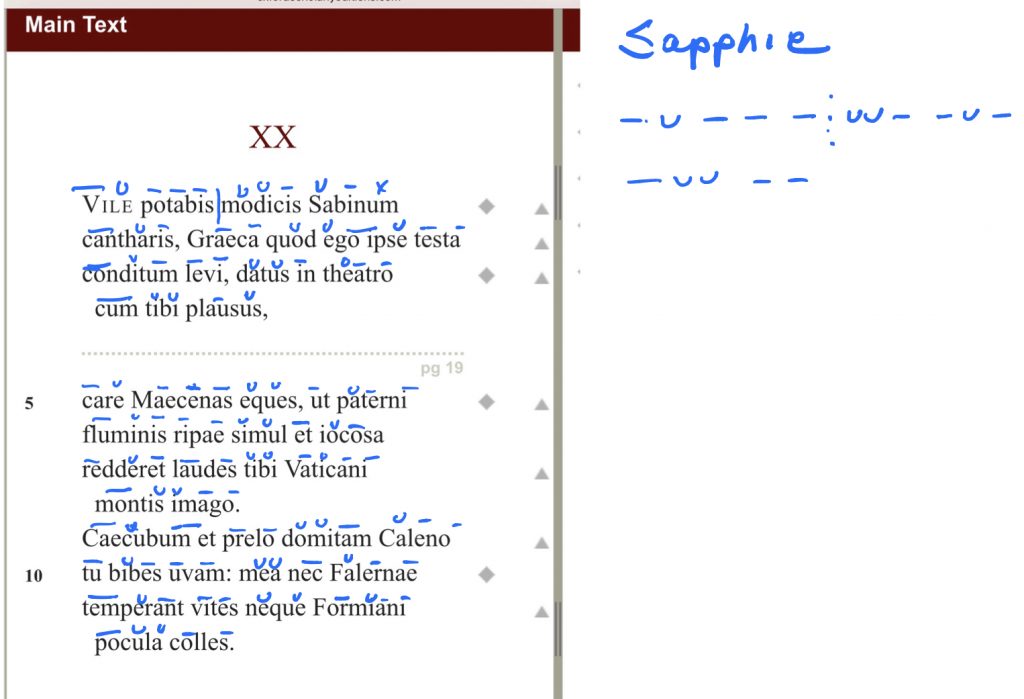
Odes 1.20

Auxilia Horace Ep. 1.9
All of the epistles are written in dactylic hexameter.
Claudius: Tiberius Claudius Nero
Septimius: also recipient of Odes 2.6 but otherwise unknown; in their (magisterial) commentary on that poem, Nisbet and Hubbard state (Horace [Quintus Horatius Flaccus], 6. in Robin G. M. Nisbet and Margaret Hubbard (eds), A Commentary on Horace: Odes, Book II; Published in print: 1978; Published online: July 2015):
“Septimius is described by Porphyrio as an eques Romanus who was a commilito of Horace; the latter statement is probably a bad guess, based on 8 militiaeand the supposed analogy of Pompeius in the next poem. Horace may have been considerably older, as he confidently expects to predecease his friend (22 ff.); when he recommends him to the young Tiberius, perhaps about 21 b.c. (epist. 1. 9), he is hardly speaking of a middle-aged contemporary. He describes Septimius in the epistle as fortem … bonumque (1. 9. 13); the compliment is conventional, yet fortem suggests the more active virtues. The ambitious young man did well in the imperial household, and was promoted in due course to the inner circle; the success of his career is shown by Augustus’s letter to Horace ‘tui qualem habeam memoriam poteris ex Septimio quoque nostro audire; nam incidit ut illo coram fieret a me tui mentio’ (Suet. vit. Hor. 30 ff. Rostagni).”
quanti: genitive of value
scilicet: apparently
legentis: genitive with Neronis
validius: comparative adverb
timui ne: fear clause
finxisse: from fingere: here “to misrepresent as”
“
Personal Qualities
I started working on the list that Davidson gives for its peer review page. My best advice is to look carefully at the letters we read this term. Some of the qualities valued on the peer review page don’t translate easily or well. They will be almost always better expressed by verbal phrasing than just a list of nouns and adjectives.
Character and Personality
The following ratings will be used to compare this student with other very capable students. Please make them as realistic as you can in comparison with outstanding students applying to other leading institutions.
Leadership: I think this is getting at the respect accrued to someone because they seem to know what they are doing–not really just someone who pushes to the front to take charge, but someone whom others don’t mind taking charge.
- consilium capere posse Latinitium
- gratia: favor one finds with others (a word that is important and has a lot of senses)
Self-confidence: “a feeling of trust in one’s abilities, qualities, and judgment”; syn: morale, confidence, self-assurance, assurance, assertiveness, self-reliance, self-possession, composure.
- to have c., fīdo, confīdo, fīsus sum, 3 intransitive
- fiducia sui, self-confidence, boldness, courage PHI
- bonum animum habere (courage)
- praesenti animo uti –to possess presence of mind.
Independence: not depending on another; capable of thinking and acting for oneself;
- legally: sui iuris esse; liber, libera, liberum
- personally: suo consilio uti; suo iudicio uti– to go one’s own way, proceed independently
- suo more vivere (this seems not really a compliment)
Character and Integrity
- note: integritas, integritatisdoes not mean “integrity” in our sense but rather wholeness “the undiminished or unimpaired condition of a thing.” I think integrity here means “honesty, respectablity”
- honestus, a,um : respectable
- opinionem virtutis habere – to have the reputation of virtue.
- mores
- poetic: integer vitae scelerisque purus (Horace)
Reaction to criticism: this has to be done with a verb phrase
- how you take something: ferre + adverb
- bene merens (merens, merentis) or bene meritus/ merita de + ablative of person
- benevolens, benevolentis
- consulere
- cura; curare
- humanitas; humanus, a, um
- benignus
Respect accorded by classmates: this one is easy (but don’t use “habere”! use fruor, frui, fructum or utor, uti usum or something –both take ablative)
- honor
- dignitas
- optima fides et fama
- honestus, a,um: regarded with honor
- dignus, a, um (+ablative of respect)
Slack Letter Three
Write a letter of recommendation for an acquaintance (familiaris, necessarius, amicus) who is applying to Davidson College. Study the letters we have read for useful vocabulary; pay attention to syntactical construction.
Use available resources!
- Latinitium: Smith and Hall Latin Dictionary
- If you search for “study” you get this marvelous entry
- Morgan Owens Lexicon
- e.g if you go to the adumbratio and search for college, one of the things you get is: school: where do you go to school (or college)? ubi studia exerces? (EGGER L.D.I. 100)
- Logeion
- helps you look for construction and other words used with the word you chose
Please address the following (as found on the peer application review for Davidson College:
- How long and how well have you known the applicant?
- What opportunities have you had to interact with and observe the applicant?
- What do you see as the applicant’s strengths?
- What do you consider to be the applicant’s weaknesses?
Please bear in mind that Latin very often uses verbs where we are inclined to use nouns!
Ad Fam. 13.6a
P. Cornelius, qui tibi litteras dedit, est mihi a P. Cuspio commendatus; cuius causa quanto opere cuperem deberemque profecto ex me facile cognosti. vehementer te rogo ut cures ut ex hac commendatione mihi Cuspius quam maximas, quam primum, quam saepissime gratias agat.
Ad Fam 13. 58
pervetus: per + vetus: very old
peto, petere: ask, seek + ab +abl (quaero, ere takes the same construction)
aditus: accusative plural
sed (peto) ut
prosum, prodesse + dative: be a benefit to
etiam atque etiam: again and again
Ad Fam 13.59
libertus, i: freedman; Trypho had been Regulus’s slave; after manumission, a freed slave still had close ties with his former owner (now called his patronus instead of dominus)
in illum: towards him (Regulus)
per se ipsum: i.e. because of Trypho’s own qualities, not because of the affection C. bears for Regulus
enim: gives reason why
fides, ei, f: loyalty
ut…debent: note indicative: ‘as’ not ‘so that’
bene meritos de se: who have deserved well of them
feceris…intellexerit: both future perfect indicatives
aderit…navigarit: perfect subjunctives in subordinate clauses in o.o. showing past time relative to main verb
navigarit=navigaverit; syncopated form
Auxilia 13.40
M. CICERO S. D. Q. ANCHARIO Q. F. PRO COS.
L. et C. Aurelios L. filios, quibus et ipsis et patre eorum, viro optimo, familiarissime utor, commendo tibi maiorem in modum, adulescentis omnibus optimis artibus ornatos, meos pernecessarios, tuâ amicitiâ dignissimos. si ulla mea apud te commendatio valuit,quod scio [multas plurimum valuisse],[haec ut valeat] rogo. quod si eos honorifice liberaliterque tractaris, et tibi gratissimos optimosque adulescentis adiunxeris et mihi gratissimum feceris.
Lucium et Gaium Aurelios Luci filios: Lucius and Gaius Aurelii, the sons of Lucius Aurelius
maiorem in modum:greatly, very much
pernecessarius,a,um: per intensive + necessarius
haec (commendatio)
gratus, a,um: read L&S on this important Latin word
